THE UNDERGROUND KNOWLEDGE SERIES I-V (Genius Intelligence Antigravity Propulsion Medical Industrial Complex The Catcher in the Rye Enigma International Banksters) by Morcan James & Morcan Lance
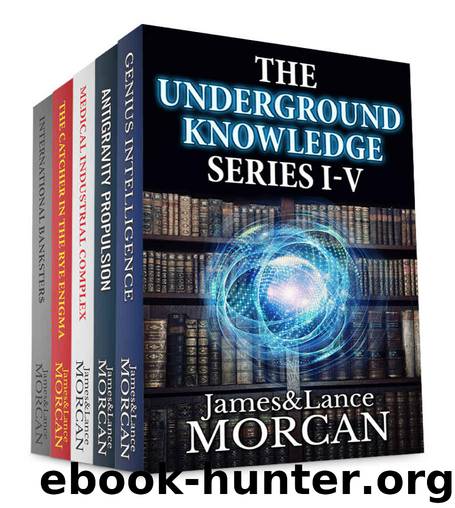
Author:Morcan, James & Morcan, Lance [Morcan, James]
Language: eng
Format: epub
Publisher: Sterling Gate Books
Published: 2015-10-23T16:00:00+00:00
“Each patient carries his own doctor inside him.” –Norman Cousins, Author of Anatomy of an Illness
The basis of many a drug or medicine, of course, is a plant or plants. These plants range from herbs, flowers, roots and leaves to common and uncommon weeds.
According to one (unconfirmed) source, there are 120 or more important drugs currently in use that have been sourced from plants. These drugs include the likes of morphine, camphor, papain, hesperidin, quinine, codein, ephedrine, strychnine and thymol .
Under the heading ‘Plant based drugs and medicines,’ the natural health site Rain-tree.com features an interesting article by alternative health commentator Leslie Taylor on this very subject.
Taylor says the plant chemical quinine “which was discovered in a rainforest tree ( Cinchona ledgeriana ) over 100 years ago” is a good example of a plant that has been chemically copied or synthesized by laboratories and is a good example of a drug in which no plant materials have been used in its manufacture.
The article continues, “For many years the quinine chemical was extracted from the bark of this tree and processed into pills to treat malaria. Then a scientist was able to synthesize or copy this plant alkaloid into a chemical drug without using the original tree bark for manufacturing the drug. Today, all quinine drugs sold are manufactured chemically without the use of any tree bark”.
This got us thinking… How many plants are being unnecessarily synthesized and sold over the counter as wonder drugs to an unsuspecting public?
Remember, the pharmaceutical companies cannot patent anything that occurs organically in nature. So there’s no incentive for them to harvest, develop and sell herbs, leaves or any other plants. Far more profitable to synthesize or copy those plants, patent the resulting drugs and medicines, and then sell them.
What if those patented drugs and medicines are less effective in the treatment of diseases and illnesses than the actual plants they are derived from? Think of the cost-savings – not to mention the health benefits to be gained by ingesting or applying natural substances as opposed to toxic chemicals.
Has that occurred to anyone else?
It occurred to us during our research for this book when someone very close to us – let’s call him Mr X – sought treatment for the very common solar keratosis, or sunspots, at a local skin clinic. Mr X was attracted by the clinic’s advertised use of a new drug, Picato , which is an extract of milkweed – also known as radium weed and cancer weed.
Said to work considerably faster than other topical medications, dosing is completed in just two to three days (compared to two to four weeks for competitive products). As you can imagine, the skin’s reaction to such a powerful medication is quite dramatic. Users suffer drastic reddening of the skin and often painful blisters.
Turns out the Picato treatment is very expensive – and quite toxic. Like the better known and more widely used Efudex treatment (for sunspots), Picato is potentially harmful to the liver and therefore the recommended dosage per treatment is wisely limited.
Download
This site does not store any files on its server. We only index and link to content provided by other sites. Please contact the content providers to delete copyright contents if any and email us, we'll remove relevant links or contents immediately.
The Art of Coaching Workbook by Elena Aguilar(51141)
Trainspotting by Irvine Welsh(21613)
Twilight of the Idols With the Antichrist and Ecce Homo by Friedrich Nietzsche(18607)
Fangirl by Rainbow Rowell(9216)
Periodization Training for Sports by Tudor Bompa(8238)
Change Your Questions, Change Your Life by Marilee Adams(7720)
This Is How You Lose Her by Junot Diaz(6859)
Asking the Right Questions: A Guide to Critical Thinking by M. Neil Browne & Stuart M. Keeley(5742)
Grit by Angela Duckworth(5580)
Red Sparrow by Jason Matthews(5451)
Paper Towns by Green John(5165)
Room 212 by Kate Stewart(5093)
Ken Follett - World without end by Ken Follett(4707)
Housekeeping by Marilynne Robinson(4424)
The Sports Rules Book by Human Kinetics(4367)
Double Down (Diary of a Wimpy Kid Book 11) by Jeff Kinney(4253)
Papillon (English) by Henri Charrière(4239)
The Motorcycle Diaries by Ernesto Che Guevara(4074)
Exercise Technique Manual for Resistance Training by National Strength & Conditioning Association(4049)
